
Definition of Google Ads
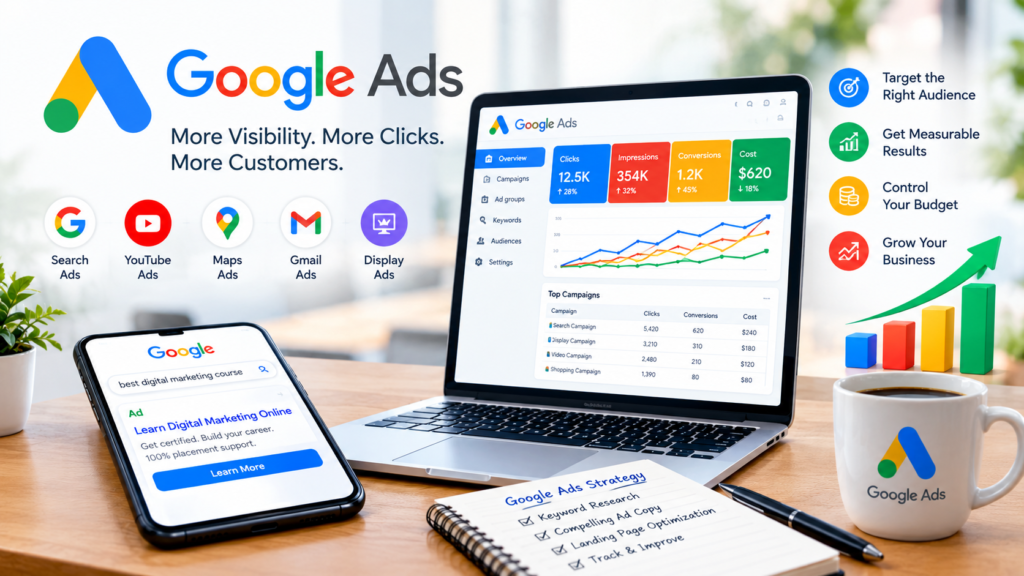
Google Ads is Google’s online advertising platform that enables businesses to display advertisements across Google Search, YouTube, Google Maps, Gmail, the Google Display Network, and partner websites. It operates primarily on a Pay-Per-Click (PPC) model, where advertisers generally pay when users click on their ads. The platform allows businesses to reach potential customers based on keywords, interests, demographics, location, device type, and online behavior.
Google Ads helps businesses connect with users at different stages of the buying journey. A local service provider can target people searching for immediate solutions, while an e-commerce store can showcase products through Shopping Ads. Businesses can choose from multiple campaign types, including Search, Display, Video, Shopping, App, and Performance Max campaigns, depending on their marketing objectives.
One of the biggest advantages of Google Ads is measurability. Advertisers can track clicks, impressions, conversions, sales, phone calls, and return on investment (ROI) in real time. This data-driven approach allows marketers to optimize campaigns continuously and improve performance. As digital competition increases, Google Ads remains one of the most powerful tools for businesses seeking targeted visibility, lead generation, and online growth.
What is Google Ads?
Google Ads is a digital advertising solution that helps businesses appear in front of customers when they search for products, services, or information online. Instead of waiting for customers to find a business organically, advertisers can place their message directly in front of interested users.
For example:
- A digital marketing agency can show ads when someone searches for “SEO services near me.”
- A clothing store can display product ads to users searching for “men’s formal shirts.”
- A restaurant can promote its location to nearby customers using location targeting.
Why Google Ads is Important for Businesses
Google processes billions of searches every day, making it one of the largest platforms for reaching potential customers. Businesses use Google Ads because it delivers highly targeted traffic and measurable results.
Key Benefits
- Instant visibility on Google Search.
- Highly targeted audience reach.
- Flexible advertising budgets.
- Real-time campaign tracking.
- Increased lead generation opportunities.
- Better brand awareness.
- Scalable marketing solution for businesses of all sizes.
- Ability to measure ROI accurately.
How Google Ads Works
Google Ads uses an auction system to determine which advertisements appear for a specific search query. The platform considers factors such as bid amount, ad relevance, expected click-through rate, and landing page experience when deciding ad placement.
Basic Process
- Select campaign objective.
- Choose keywords or audience targeting.
- Create advertisements.
- Set budget and bidding strategy.
- Launch campaign.
- Monitor performance.
- Optimize based on data.
Example
If a user searches for “best digital marketing course in Lucknow,” training institutes running Google Ads for that keyword may appear at the top of search results.
Types of Google Ads Campaigns
1. Search Campaigns
Search Ads appear directly on Google search results pages. They are ideal for generating leads, inquiries, and website traffic.
Example:
A plumber bidding on “emergency plumbing service” can appear when customers need immediate assistance.
2. Display Campaigns
Display Ads appear as banners and visual advertisements across millions of websites and apps within Google’s network.
Example:
A travel company can display attractive holiday package banners to users browsing travel-related websites.
3. Video Campaigns
Video Ads appear on YouTube and other video partner platforms. These campaigns help improve brand awareness and customer engagement.
Example:
A smartphone brand launching a new device can use video ads to demonstrate product features.
4. Shopping Campaigns
Shopping Ads showcase products with images, pricing, and store information. These are highly effective for e-commerce businesses.
Example:
An online electronics store can display laptops with prices directly in search results.
5. App Campaigns
These campaigns help businesses increase app downloads and user engagement across Google’s platforms.
Example:
A food delivery app can promote installations among users interested in online ordering.
6. Performance Max Campaigns
Performance Max uses Google AI to optimize ads across multiple channels from a single campaign.
Example:
A retail brand can simultaneously advertise on Search, Display, YouTube, Gmail, and Maps.
Best Practices for Successful Google Ads Campaigns
Follow These Proven Strategies
- Conduct detailed keyword research.
- Write compelling ad copy.
- Use strong call-to-action phrases.
- Optimize landing pages.
- Install conversion tracking.
- Test multiple ad variations.
- Monitor campaign performance weekly.
- Exclude irrelevant keywords.
- Use audience segmentation.
- Optimize for mobile users.
Common Mistakes to Avoid
- Targeting broad keywords without research.
- Ignoring negative keywords.
- Sending traffic to poorly designed landing pages.
- Not tracking conversions.
- Using weak ad headlines.
- Setting unrealistic budgets.
- Failing to optimize campaigns regularly.
Frequently Asked Questions (FAQ)
1. What is Google Ads?
Google Ads is Google’s advertising platform that allows businesses to promote products and services across Search, YouTube, Maps, and partner websites.
2. Is Google Ads suitable for small businesses?
Yes. Businesses can start with small budgets and scale campaigns as results improve.
3. How much does Google Ads cost?
There is no fixed cost. Advertisers control spending through daily and monthly budgets.
4. Which campaign type is best?
The best campaign depends on your goal. Search campaigns are effective for leads, while Shopping campaigns work well for e-commerce businesses.
5. How quickly can Google Ads generate results?
Many campaigns begin generating traffic shortly after approval, although optimization improves long-term performance.
6. Can Google Ads increase sales?
Yes. By targeting users actively searching for products or services, Google Ads can significantly improve sales opportunities.
Conclusion
Google Ads is one of the most effective digital marketing platforms available today. It enables businesses to reach potential customers at the right moment, whether they are searching for information, comparing products, or ready to make a purchase. With campaign options such as Search, Display, Video, Shopping, App, and Performance Max, businesses can create highly targeted advertising strategies that align with their goals. By focusing on keyword research, compelling ad copy, conversion tracking, and continuous optimization, organizations can maximize their return on investment and achieve sustainable online growth. In an increasingly competitive digital marketplace, Google Ads remains a powerful solution for generating visibility, leads, and revenue.